
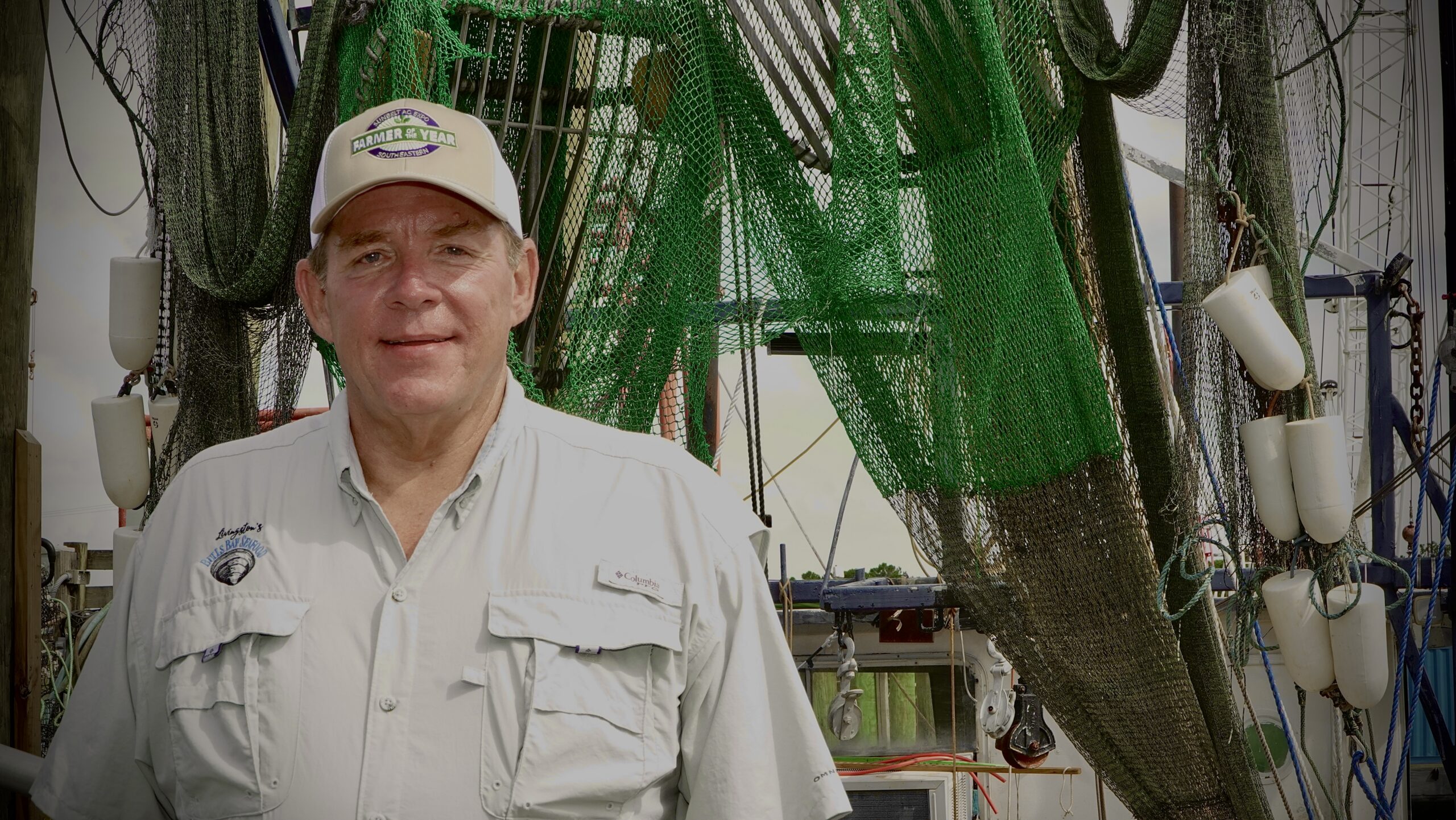
After marrying into a family in the seafood business, Jeffrey Massey soon developed his passion for the industry. For the past 26 years, he’s spent his career working to advance the family business by growing clams and oysters, advocating for the seafood industry, and teaching the next generation the value and skills needed to pursue a career in aquaculture. Today, Massey owns Livingston’s Bulls Bay Seafood, where he and his wife manage the seafood business’s clam and oyster production alongside shrimp and soft shell crabs.
At the start of his career, Massey witnessed the economic viability of clam farming in Florida. He and his father-in-law, Bill Livingston, decided to give it a try. They attended Harbor Branch Oceanographic Institute at Florida Atlantic University’s Hatchery Management Class along with the Algae and Rotifer growing class, while managing the full-time seafood business back at home. After learning the basics in 1999, they dove in headfirst by purchasing clam seed and planting. In 2000, they harvested their first clam crop and have been growing ever since.
As with any farming operation, understanding the importance of diversification is crucial for success.
“A key goal of our operation has been to diversify our products to reduce risk and create more opportunities within the marketplace,” said Massey. “In addition to clam farming, we produce single oysters, cluster oysters, soft shell crabs and also sell American wild-caught shrimp.”
The diversification of the operation allows for a broader range of locally harvested seafood to customers of Livingston’s Bull Bay Seafood while strengthening the economic stability of the farm. Even with diversification, the commitment to freshness and sustainability remains the same. All seafood sold from the business is always fresh and local. In 2018, Massey and his wife, Kim Livingston, purchased the business from Kim’s parents, Bill and Kathy Livingston. They continue to advise and help when needed. Massey’s operation markets seafood directly to consumers through Facebook, their website, and word of mouth. With a strong local following and positive referrals from happy customers, their business continues to be a hotspot for locals and tourists after fresh seafood.
“Our reputation for fresh, high-quality seafood and responsible farming practices has helped establish us as a trusted local source for sustainably produced shellfish,” said Massey.
The farm has been featured on the Making It Grow program produced by South Carolina Educational Television, which highlighted the aquaculture operation. In 2016, the farm was featured on Bizarre Foods with Andrew Zimmern on the Travel Channel. The national television appearance showcased South Carolina shellfish aquaculture at large and brought attention to their local farm. While these public opportunities have showcased their business and story, it’s also appealed to a wide audience by highlighting the sustainable practices of locally produced seafood.
With environmental stewardship as a fundamental part of the operation, Massey makes each business decision with sustainability in mind. While shellfish and aquaculture produce healthy seafood, it also contributes directly to improving water quality. At any time throughout the year, Massey has approximately 500,000 clams growing in the water. One mature clam can filter 40 gallons of water per day. Clams take anywhere from 18 months to two years to mature. This means year-round, the clam crop is filtering at least two million gallons of water per day. The oysters also contribute significantly to clean water. With 45,000 single oysters in the water, which can filter 50 gallons of water a day, the oysters are filtering over 2.2 million gallons of water a day. Combined, the shellfish farm naturally filters at least 4.2 million gallons of water per day by removing excess nutrients, suspending particles from the water, and improving water clarity. The farm is situated in the middle of a wildlife refuge, and this natural filtration process significantly improves the overall health of the ecosystem. This not only benefits local food production, but also the long-term sustainability of the coastal environment.
While dedicated to his operation, Massey also believes strongly in the support and growth of the aquaculture community at large. In 2022, he helped form the Cape Romain Oyster Co-Op with assistance from Clemson Cooperative Extension. The cooperative was formed to help local shellfish farmers strengthen their farming, sales, and marketing efforts. Through the cooperative, farmers are able to pool resources, share infrastructure, and access larger buyers. The co-op also allows participating farms to utilize their facilities for processing and handling, helping create a more efficient and collaborative seafood supply chain. This initiative has helped support other local farmers while strengthening the overall aquaculture industry in the region.
Massey understands the value in investing in the next generation of aquaculture farmers, and he has taken unique steps to do just that. After finding out about a commercial seafood apprenticeship program in Rhode Island, he and another farmer, Pete Kornack, took a trip there to learn what it was about. They were impressed by the program and decided South Carolina needed something similar. With the support of South Carolina Sea Grant Consortium, the Clemson University Cooperative Extension program, the McClellanville Community Foundation, and the town of McClellanville, they worked to get funding and create a program, and this year marks three years of the Commercial Seafood Apprenticeship Program in South Carolina. Each year, they receive an influx of applications, but it is limited to 12 students each session. The idea behind the program is to expose and train entrepreneurs about commercial seafood. During the four-week program, interns are paid to learn about practices of commercial fishing and the seafood industry. The goal of the program is to expose and encourage more people to pursue aquaculture and commercial seafood for a career.
Zach Snipes, Clemson University Cooperative Extension Specialist, nominated Jeffrey Massey for South Carolina Farmer of the Year.
“I have known Jeff Massey and his family for nearly a decade, and over the
past five years we have served together on the Farm Bureau Board,” said Snipes. “During that time, I have seen firsthand his dedication to both the organization and the seafood industry. Jeff naturally steps into leadership roles and consistently works to advocate for policies that support commercial seafood producers and the broader coastal community. What stands out most is his commitment to serving others. Through the commercial seafood apprenticeship program he helped found, Jeff has created opportunities to train and mentor the next generation while helping preserve South Carolina’s working waterfront heritage.”
Massey currently serves as Vice-Chairman on the Charleston County Farm Bureau Board. He is also the chairman for the SC Farm Bureau Diversified Agriculture State Committee. His wife, Kim Livingston, is a National Board-Certified Media Specialist with the Charleston County School District. She is also serving on the Charleston County Farm Bureau Women’s Committee and is a founding member of the McClellanville/Awendaw Begin With Books Foundation. Their son, Jake Massey, works full-time at Safe Harbor Marinas and has an oyster roasting business where he promotes and sells oysters from Livingston’s Bull Bay Seafood. Their daughter, Katie Massey, is specifically skilled in shedding soft shell crabs and helps with the business in between her college schedule. She is currently in a graduate program at the University of South Carolina pursuing a masters in Speech-Language Pathology. Massey works closely in the family business with his in-laws, which has played a significant role in his career.
“None of this would be possible without the help of my family, our employees, our community, SC Farm Bureau, Clemson Cooperative Extension Program, SC Sea Grant and SC Rural Development. Their efforts to protect the environment and the local working waterfronts have been tremendous.”
A distinguished panel of judges will visit each finalist in August and the winner will be announced during the 2026 Sunbelt Ag Expo Southeastern Farmer of the Year Luncheon.
Returning program sponsors in 2026 are Harper Family Holdings, the Alabama Farmers Federation, Arkansas Farm Bureau, Florida Farm Bureau, Georgia Farm Bureau, North Carolina Farm Bureau, South Carolina Farm Bureau, Virginia Farm Bureau, the Georgia Association of Conservation Districts, Ag Georgia Farm Credit, Ag South Farm Credit, and SW Georgia Farm Credit and Arkansas Farm Credit. New sponsors for 2026 include Phoebe Putney Health Systems.
As the state winner of the Sunbelt Expo award, they will receive a $2,500 cash award and an expense-paid trip to the Sunbelt Expo from the sponsors. A vest from the sponsors will be given to each state winner and nominator. The Moultrie Colquitt Co. Chamber of Commerce will give each state winner a local keepsake.
The state winners are now eligible for the $15,000 cash prize awarded to the overall winner by the sponsors. Massey Ferguson North America will provide each state winner with a gift package and the overall winner with the use of a Massey Ferguson tractor for a year or 250 hours (whichever comes first). A jacket from the sponsors will be given to the overall winner. Hays LTI will award the overall winner with a HAYS Smoker/Grill. In addition, the overall winner will receive a Henry Repeating Arms American Farmer Tribute Edition rifle from Reinke Irrigation and a diesel prize package from Howes.