PRESENTED BY MASSEY FERGUSON
Liliane Silva, Clemson | Katie Mason, UT | Lisa Baxter, UGA | Uttam Saha, UGA
 The Southeastern Hay Contest (SEHC) has proudly recognized our regional producers who grow and harvest high-quality hay for the last 23 years. The contest was originally developed by Extension agents for Southeast forage producers. Their involvement was pivotal to the success of this program during its development in 2004 and will continue to play an important role into the future. The SEHC continues to fulfill its mission to raise awareness of the importance of hay testing and of managing livestock feed needs through nutritive value determination. The samples are ranked based on relative forage quality (RFQ), and the top 3 entries in each category receive a cash prize. The overall winner also receives a choice of the use of a new Massey Ferguson DM Series disc mower or RK Series rotary rake for the 2027 hay production season, plus $2,000 in cash!
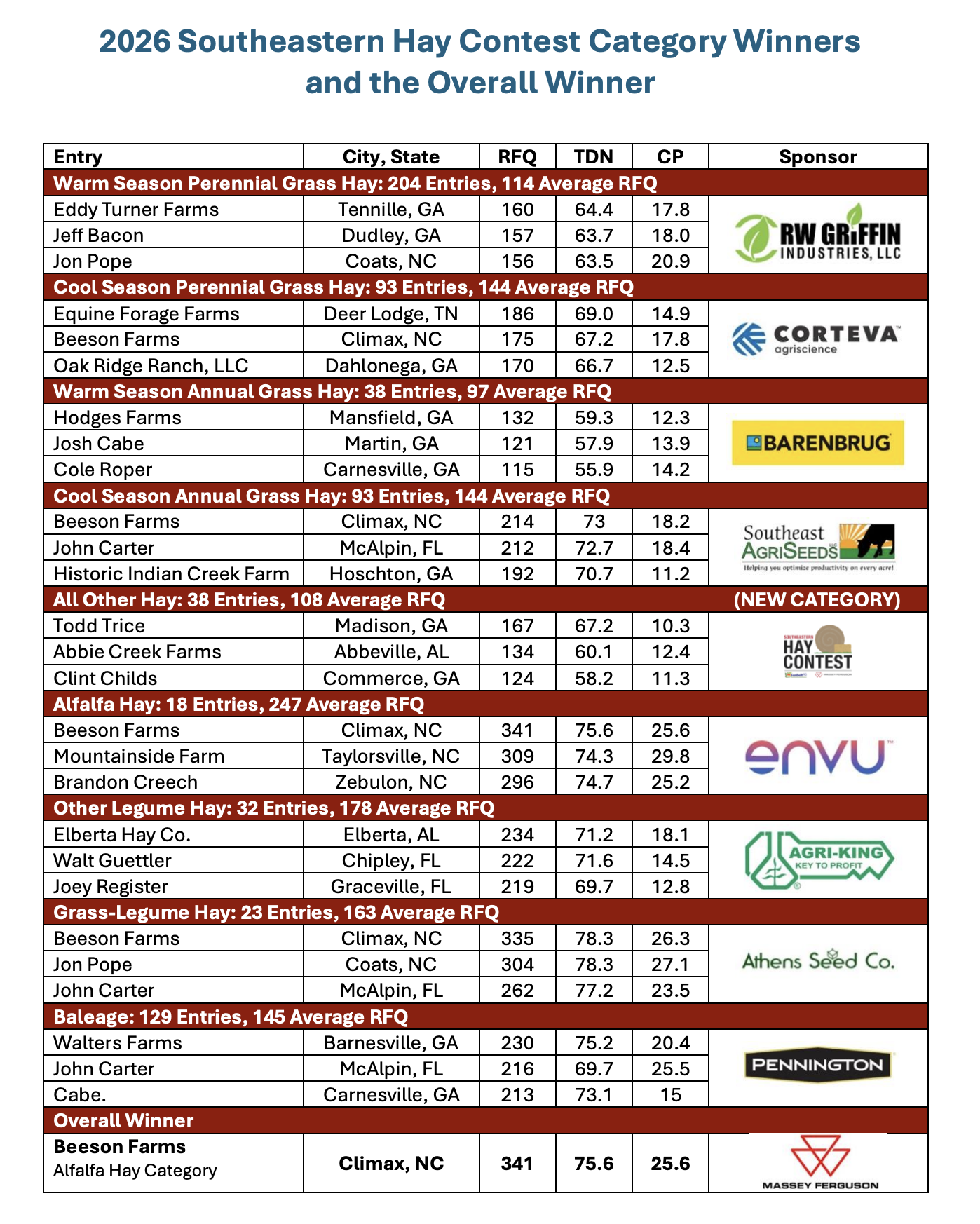
Entries into the 2026 SEHC surpassed previous years and set a new record number of entries at 628 submissions from ten states across the Southeast. Despite climatic challenges over the last year, there have been some very high-quality stored forages produced. This year’s category winners are summarized in the table below. The 2026 Grand Prize goes to Beeson Farms from Climax, NC, from the alfalfa hay category, with another incredible RFQ of 341.
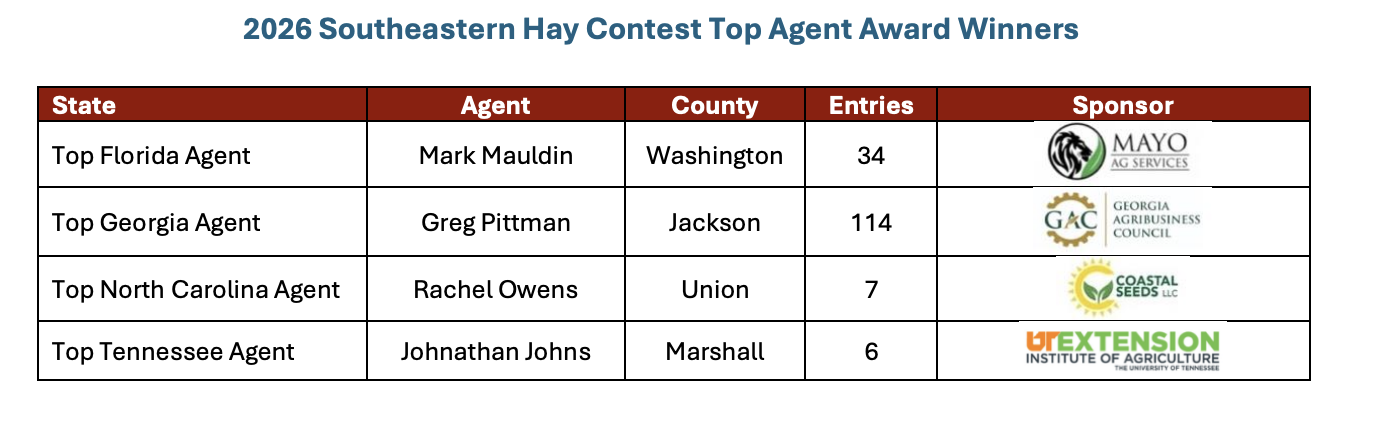
The SEHC continues to increase its reach and strengthen its commitment to education. Again, we would like to acknowledge the efforts of our Extension agents, who engage producers and collect samples. The agent award winners are in the first table below. We encourage you to continue the tradition and “prove your hay is the best” by submitting samples to next year’s contest. Submissions are open year-round; check www.sehaycontest.com for more information, or contact your local county agent or forage Extension specialist.
What is Relative Forage Quality?
RFQ is an index used to represent different forages relative to their overall nutritive value (total digestible nutrients) and predicted dry matter intake. The index was developed by researchers at the University of Florida and University of Wisconsin and is consider a better fit for comparing forages (especially southern forages) for accounting for the digestible fiber as determinant of intake. In the past, hay quality prediction equations were based on the fiber concentration of the hay crop. However, forage crops can have similar fiber content but have very different digestibility. For instance, Tifton 85 bermudagrass often has a higher fiber concentration than other bermudagrass varieties, yet it is more digestible. This improved digestibility results in enhanced animal performance but is not reflected just considering traditional forage nutritive value parameters. This value is a single, easy to interpret number that improves producer understanding of a forage’s nutritive quality and helps in establishing a fair market value for the product. Since 2003, hundreds of warm season samples have been used to refine the RFQ equation for bermudagrass and other warm season forages at the UGA’s Feed and Environmental Water Lab in Athens, the official SEHC laboratory.
How can Relative Forage Quality help me?
RFQ allows hay producers to easily categorize and price hay lots based on relative quality, and livestock producers to balance supplemental diet based on the quality of the hay being offered. Producers can purchase hay lots depending on its end use. For example, there is little need to feed high-quality hay to livestock that could easily utilize poorer quality forage. Hay with a RFQ of 100 or more can usually be economically fed to maintain beef cows, while hay with an RFQ of 125-150 is adequate for stocker cattle or young growing replacement heifers, and hay with an RFQ of 140-160 is suitable for dairy cattle in the first three months of lactation. It is also easy to see that Relative Forage Quality could provide the framework for a quality hay marketing system. For instance, hay with a RFQ of 155 could conceptually be labeled “premium” hay, while hay with an RFQ of 100 could be labeled “fair”. This simple system could allow producers to price hay consistently and fairly across harvest maturity, fertilization regimes, or plant species (i.e. bermudagrass, bahiagrass, perennial peanut, or tall fescue).
2026 SEHC Executive Committee Contacts
Dr. Liliane Silva (lseveri@clemson.edu)
Dr. Katie Mason (kmason21@utk.edu)
Dr. Lisa Baxter (baxterl@uga.edu)
The Southeastern Hay Contest is a collaboration between these 13 University Extension Services.